





Gold mining untaxed and hardly paying royalties
“It is fair to facilitate the work of small operators and cooperatives, and their contribution to the State should be smaller than the contribution of companies; but royalties must be the same for everyone because the value of the wealth extracted from a territory must serve for the development...
In accordance with legal norms in Bolivia, revenue for the State from mining comes from two sources: taxes and royalties.
On the tax side, the rate is applied to the type of operator: large or medium-sized enterprises must pay 37.5% of the profits, while cooperatives (supposedly non-profit organizations) are released from profit taxes, so they pay 0% for this item.
On the side of the royalties, if the gold comes from a good deposit it should pay 7% on the market values; but a special royalty tax rate of 2,5% was created for marginal reservoirs, which can only be exploited by artisanal methods. This low royalty was intended to favor small miners and cooperatives that could not access good deposits, and to encourage irregular operators to formalize their operations.
The problem, cautions Jubilee, is that these combined conditions have been exploited “by both foreign smugglers and local operators. They make it appear as if their intensive production came from marginal fields or as if they were cooperatives”.
This also occurs with Peruvian informal production, clandestinely entering Bolivia and being registered as cooperative production from marginal fields, only to be re-exported.
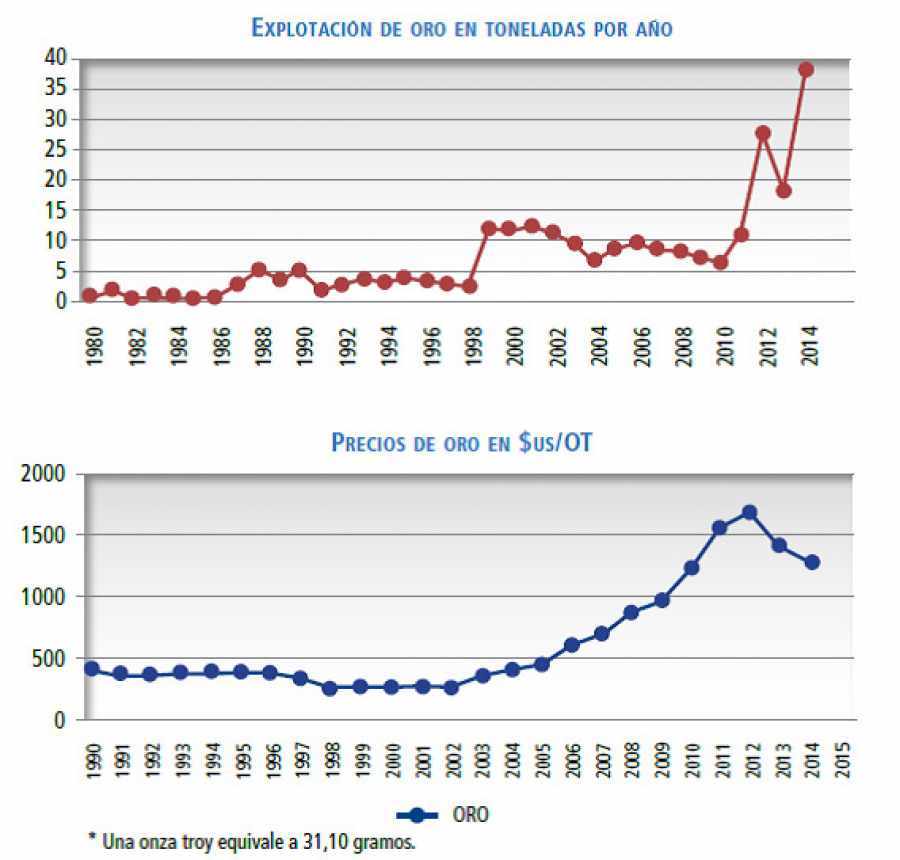
This situation seems to have been replicated, in a way, with larger companies. According to data from the Ministry of Mining, in 2012 gold production (self-described as marginal) of about 30 tons was recorded and rose to nearly 40 tons in 2014. Until 2007, the main operating gold company was Inti Raymi, which, with cutting edge technology could produce 10 tons per year.
“If a company with the best technology produced 10 tons per year, is it possible that marginal-artisanal and small scale sites, and through cooperatives, could produce 30 tons?”, Jubilee questions. With things as they are, not only cooperative or marginal producers are benefiting from very low tax rates and royalties.
Production and export
According to data from the Ministry of Mining, until 2010 the share of gold trading represented less than 10% of the Bolivian mining exports. It rose to 14% in 2011 and in 2012 leaped forward to reach 47.89%, almost half of all metal exports. In 2013 it fell to 27.63% and in 2014 went back to 34.52%, maintaining its importance.
Jubilee’s analysis considers that “should this be Bolivian gold; it would have had a market value of nearly $1.500 million while the country is left with less than 40 million in royalties. That is, more than $1.400 million remained in the hands of the operators”.
Furthermore, “in these operations -self-identified as marginal- the operating cost is about 30% of the value of the metal. For the year 2012, that cost would become $440 million. Nearly, $1.000 million remained in the hands of operators as net income, no taxes have been paid for this amount”.
Is it correct to lower royalties?
Royalty is the compensation to a territory where wealth is extracted, for the impact produced by the extraction and to generate development in the territory.
With this premise in mind, Jubilee believes that “stakeholders should be consulted to grant a reduction of royalties (namely the regions or territories where non-renewable resources are extracted) whether they are, or are not, in accordance to lowering their income to favor workers in the sector, against the collective income that may be useful for the whole community”.
Posible aternatives
Faced with such situations, “the state should explore other mechanisms to help small-scale operators; but need not be only the region to reduce their income to do so”, says Jubilee.
As an example, the organization proposes that if the royalty were to rise to 7% for any operator, other compensations could be applied for those small producers, so that reasonable incomes are guaranteed, so “it is necessary to study how much of this compensation should come from the General Treasury of the Nation (GTN) and how much from regional coffers”.
According to Jubilee, with a royalty of this magnitud it is likely that “smuggling from Peru to Bolivia would slow down and, with local production, royalties should be as high or higher than what the state has been receiving during the last years”.
Another aspect that should be analyzed in detail is the permitted utility level allowed by operators (Company, cooperatives, etc.), because when the price of gold is high in the market and the cost of operation does not rise significantly, then “those surpluses are very large and their distribution should no longer correspond among a few people, so that the benefit should reach to other sectors of the population”.

 Acceder


