





ECLA: lack of demand, ample liquidity, more inequality in the world
In a recent report entitled “Horizons 2030: Equality at the Centre of Sustainable Development”, The Economic Commission for Latin America (ECLA) -the Spanish acronym is CEPAL- indicates that there is a “recessive trait” in the global economy, marked by a lack of aggregate demand,...
According to the report, “China, Germany and oil exporting countries have been consistent in growing a surplus regarding the current account in the balance of payments, while Latin American and Caribbean countries had surpluses for a very brief period during the commodities boom”.
A particular case is that of the United States, who, as issuer of the international reserve currency, may not feel much pressure to adjust despite their high deficits, providing liquidity to the world.
Thus, ECLA points out, “the lack of global coordination confers a recessionary bias to the overall system; as a way out of this impasse and to promote growth, a global Keynesian policy is needed, where surplus countries contribute their demand to rebuild global balances”.
When speaking about “Keynesian policy", ECLAC refers to the famous British economist John Maynard Keynes, who in the 1930s questioned the ideas of free market arguing that it is actually aggregate demand (total demand for goods and services in an economy over a period of time) that determines the overall level of economic activity, and that inadequate aggregate demand can lead to long periods of high unemployment.
According to Keynes, state intervention is necessary to moderate the cycles of “boom and bust” in the economy using fiscal and monetary policies to mitigate the adverse effect of recession.
The English economist also stressed that in the international economy, the contribution to be made by the debtor country to restore balance by adjusting prices and wages is disproportionate in relation to that required of its creditors.
It is in this sense that ECLA considers an institutional structure to be necessary (which currently does not exist in the global system) in order “to take full employment and growth as key objectives, as proposed in the 2030 Agenda for Sustainable Development and the ODS”.
Financial sector is increasingly larger than the real one
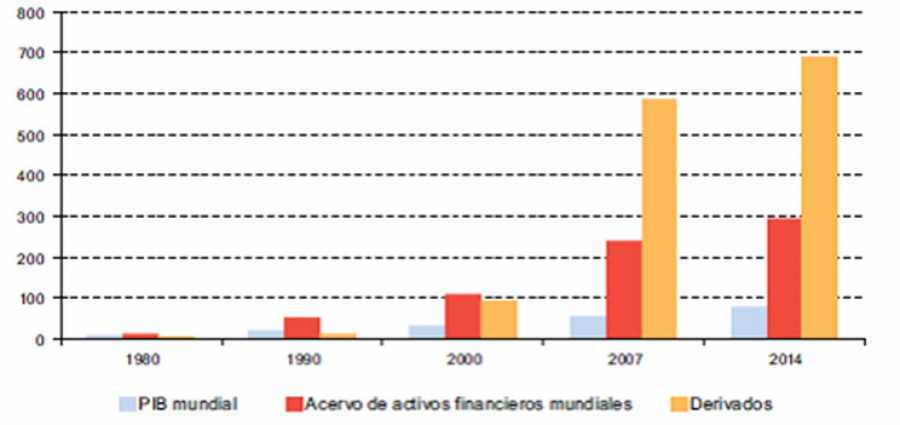
“Paradoxically, the lack of aggregate demand coexists with excess liquidity. The financial system follows a self-sustained path of multiplication of its assets, which has contributed to an imbalance in the current account and the subsequent issuance of debt securities”, the ECLA report said.
According to data presented by the organization, the difference in magnitude if financial assets – and in particular of financial derivatives – relative of world GDP is enormous and growing: in 2014 world GDP did not reach 100 trillion dollars, while the value of financial assets was around 300 trillion, and the value of these derivatives was approaching 700 trillion.
In this context, ECLA warns that “the disruptive potential of financial wealth that increases rapidly and far exceeds production and trade volumes is extremely high”.
But the factors behind these imbalances are not only commercial and financial: “the existing technological and productive asymmetries between countries are at the base of the differences in competitiveness and trade imbalances”.
An unequal world, worse economic performance
According to the 2015 Organization for Economic Cooperation and Development (OECD) report, in the developed world and in several developing regions, inequality is at its highest level in more than three decades, both in developed countries that have traditionally had higher levels of inequality (USA) and in countries with a strong egalitarian tradition, such as the Scandinavians.
ECLA agrees that global inequality increased considerably: “Almost all countries in which inequality was reduced are Latin American countries, where inequality levels initially were – and still are – of the highest in the world”.
While some experts have noted that certain levels of inequality are positive in order to motivate economic actors, the organization warns that “several problems are associated with high inequality: the most unequal countries tend to show a worse economic performance, greater political instability and stronger limits on the right to exercise full citizenship. Greater inequality makes it more difficult to reduce poverty, efforts that will depend even more on economic growth”.
Meanwhile, academics Mark Setterfield and Jon Wisman, have showed in different reports that increasing inequality contributed to the global financial crisis of 2008 and 2009, first in the US and then globally: to the extent that the share of wages in income fell, families resorted to borrowing, especially for house purchases, while at the same time the sectors favored by the concentration used their income on financial assets, not on consumption or productive investment.

 Acceder


