





PCDI: an alternative to GDP in the pursuit of sustainable and human development
“The Policy Coherence for Development Index (PCDI) is a tool designed to measure, evaluate and compare the performance of countries with a sustainable, fair and equitable human development”.
That is how the index is defined by the researchers and academics leading the initiative, which is promoted by several development organizations -such as Solidarity Alliance Foundation, Mundubat-Mundubat Fundazioa Foundation, Trade Union Institute for Development Cooperation (ISCOD), Peace Foundation, Serafin Aliaga Peace and Solidarity Workers’ Councils Foundation, IEPALA Foundation, Economist Without Borders, Spanish Commission Refugee Aid (CEAR), Dignity with Peace, AIETI and Movement for Peace-.
This proposal is an alternative to the hegemonic and limited view of the indicators that are commonly used to measure progress and development, in particular the Gross Domestic Product (GDP).
Roberto Laserna, an economist and researcher at the Centre for the Study of the Economic and Social Reality (CERES), previously cautioned that “the GDP is so popular that we rarely question the theoretical model that underpins its calculation and continues to guide economic policy errors”.
Other analysts also note that GDP is a wrong way to measure the economy, and that this misleading picture of the economy generates, in turn, government decisions that can continue damaging the emerging Bolivian production system.
From a global perspective and looking into its theoretical foundations, PCDI researchers believe “the progress of a country is only progress if it is both compatible with that of other countries and with the entire planet. Therefore, in order to measure this relationship, we developed the PCDI ".
Thus, this index seeks to analyze policies from a sustainable development perspective, taking into account not only the effects of these policies in that same country, but also in other countries or the entire planet. In this sense, the PCDI attempts to show “the entire map of sustainable development”.
The PCDI
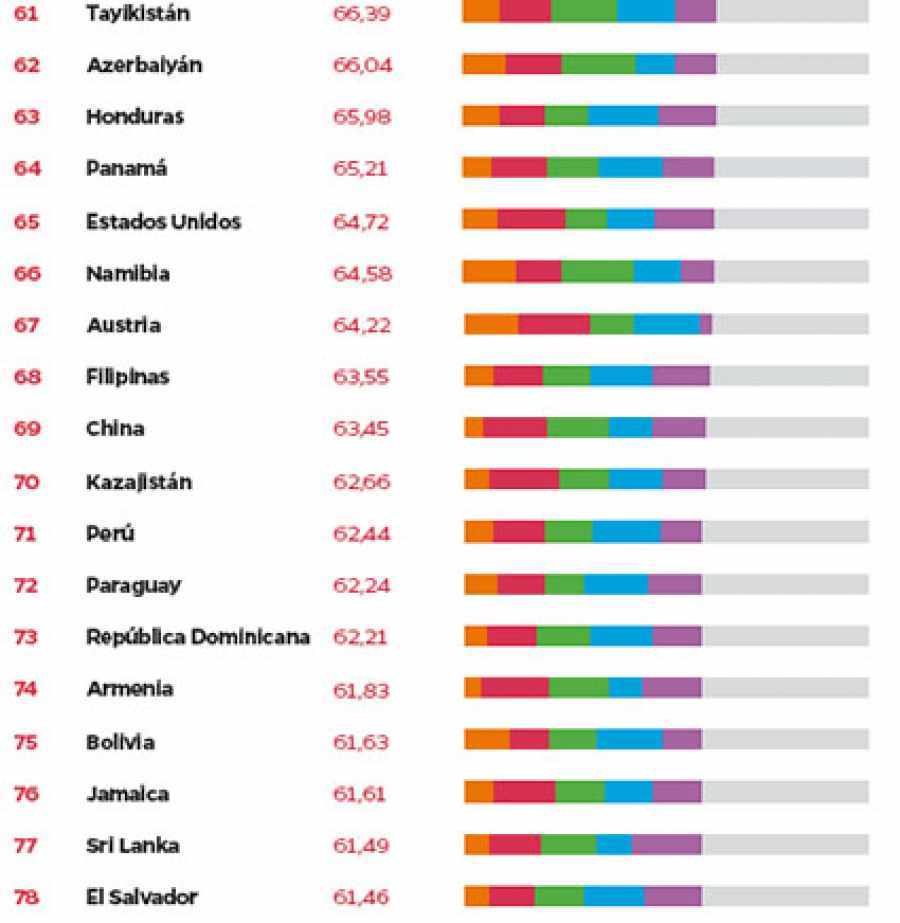
This new index measures the performance of 133 countries through the assessment of 20 public policies that are specified in 49 variables, grouped into five components: social, environmental, economic, global and productive.
Of the 49 variables, 18 refer to values contrary to sustainable development processes (for example: school dropouts, military spending or ecological footprint), whereas the other 31 show favorable values to such processes (for example: reduction of inequality, public expenditure on social welfare or ratification of universal justice treaties).
“We intend to displace and replace the GDP or the HDI (Human Development Index) as the leading reference-points that determine government policy action, betting on a tool that facilitates the evaluation of public policies, in the hope that these policies put people and the planet at the center of the development model”, said the researchers in the Index report.
PCDI overall global ranking
The 2016 PCDI shows that, in terms of policy coherence for development, the behavior of most of the 133 countries studied is very similar: the majority of the countries (87%) have a very similar performance, being located around the center of the overall ranking. Only 17 countries are located in the other two groups of high PCDI and very low PCDI.
The group of countries with a high PCDI is composed of 15 countries, led by the nordic Denmark, Sweden and Norway, which are located in the top three positions in the ranking, followed by other European countries.
The case of the UK stands out in this group, because "despite having a high PCDI and good performance in some components", this country has “very little coherence with sustainable development in the economic component. It is a country with an oversized banking sector and a high financial opacity”.
The medium PCDI group is the largest group of countries (54) ranging from position 16 (Lithuania) to the 69th (China). The United States is in this group of countries, ranked 65 on the list.
Bolivia is placed 75 on the ranking, and is in the group of countries with medium low PCDI, which ranges from the 70th (Peru) to 104th (Qatar). Saudi Arabia stands out in this group (98th): "While all other components have modest results, it is its lack of international commitment to human rights and peace that determines its position in the bottom of the list".
The cases of UAE (United Arab Emirates) and Singapore stand out among the low and very low PDCI groups. The first country is "incoherent from a perspective of sustainable development. It combines a relatively high social development with a totally unsustainable expenditure of energy and resources, placing it in the group of countries with low PCDI ".
Meanwhile, Singapore "represents perfectly how not to pursue the development of a country. It combines high social development with large financial opacity, high militarization and a very unsustainable development. Thus, it becomes the most incoherent country from a sustainable development point of view".
READ IN SPANISH
ICPD: una alternativa al PIB para crecer en otro sentido

 Acceder


